Triangle Angle Calculator – Find Missing Angles
Calculator
Please select the option and enter required values then press calculate button:
Important Formula:
Sin(θ) = Opposite / Hypotenuse
Cos(θ) = Adjacent / Hypotenuse
Tan(θ) = Opposite / Adjacent
Select what (angle / sides) you want to calculate, then enter the values in the respective rows and click calculate.
If you want to calculate hypotenuse enter the values for other sides and angle.
Frequently Asked Questions
What is the formula for a right triangle?
A right triangle uses both trigonometric ratios and the Pythagorean Theorem. The main formulas are: sin(θ)=Opposite/Hypotenuse, cos(θ)=Adjacent/Hypotenuse, tan(θ)=Opposite/Adjacent, and Hypotenuse² = Opposite² + Adjacent².
How do I calculate a missing side of a right triangle?
Enter any two known measurements, such as an angle and a side. The calculator automatically applies the appropriate trigonometric formula to determine the missing side length.
Can I use SOHCAHTOA without a calculator?
Yes. For common angles such as 30°, 45°, and 60°, exact trigonometric values can be used. For most other angles, a calculator provides faster and more accurate results.
What is the longest side of a right triangle?
The hypotenuse is always the longest side. It is located directly opposite the 90° angle and is never adjacent to the right angle.
Can this calculator find a missing angle?
Yes. If you know any two sides of a right triangle, the calculator can determine the unknown angle using inverse sine, inverse cosine, or inverse tangent functions.
What is the complementary angle in a right triangle?
The two non-right angles in a right triangle always add up to 90°. If one angle is θ, the complementary angle is 90° − θ.
How accurate is this right triangle calculator?
The calculator uses standard trigonometric functions and provides results rounded to several decimal places, making it suitable for educational, engineering, and practical calculations.
What is the difference between sine and cosine?
Sine compares the opposite side to the hypotenuse, while cosine compares the adjacent side to the hypotenuse. Both ratios are used to calculate unknown sides and angles.
When should I use tangent?
Use tangent when you know or need the relationship between the opposite side and the adjacent side. Tangent is defined as Opposite ÷ Adjacent.
Can I solve a triangle with one side and one angle?
Yes, provided the triangle is a right triangle and the known angle is not the right angle. One side and one acute angle are sufficient to calculate all remaining sides and angles.
What is SOHCAHTOA?
SOHCAHTOA is a memory aid for remembering trigonometric ratios:
SOH = Sine = Opposite ÷ Hypotenuse,
CAH = Cosine = Adjacent ÷ Hypotenuse,
TOA = Tangent = Opposite ÷ Adjacent.
Can this calculator solve hypotenuse problems?
Yes. Enter either the opposite side and angle or the adjacent side and angle. The calculator will instantly determine the hypotenuse using trigonometric formulas.
What is an opposite side in a triangle?
The opposite side is the side directly across from the selected angle. Its position depends on which angle is being used as the reference angle.
What is an adjacent side in a triangle?
The adjacent side is the side next to the selected angle, excluding the hypotenuse. It forms the angle together with the hypotenuse.
Why are right triangles important?
Right triangles are widely used in construction, architecture, navigation, surveying, engineering, physics, and computer graphics because they allow distances, heights, and angles to be calculated accurately.
How do I find the hypotenuse?
If the angle and opposite side are known:
Hypotenuse = Opposite ÷ sin(θ).
If the angle and adjacent side are known:
Hypotenuse = Adjacent ÷ cos(θ).
How do I calculate the opposite side?
Use:
Opposite = Hypotenuse × sin(θ)
or
Opposite = Adjacent × tan(θ).
How do I calculate the adjacent side?
Use:
Adjacent = Hypotenuse × cos(θ)
or
Adjacent = Opposite ÷ tan(θ).
Can this calculator solve right triangles?
Yes. It calculates missing sides and angles of right triangles using trigonometric ratios.
Right Triangle Calculator Explained
This Right Triangle Calculator helps students, teachers, engineers, surveyors and anyone working with geometry solve right-angled triangles instantly. By entering any two known measurements such as an angle and a side, the calculator can determine the missing angle, opposite side, adjacent side or hypotenuse.
The calculator uses the three primary trigonometric ratios: sine, cosine and tangent. These ratios relate the sides of a right triangle to one of its acute angles.
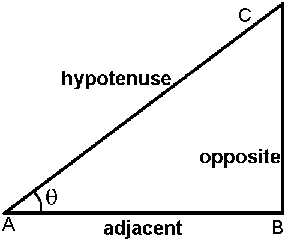
Understanding Triangle Sides
The hypotenuse is always the longest side of a right triangle and lies opposite the right angle.
The opposite side is the side directly across from the selected angle θ.
The adjacent side is the side next to the selected angle θ but not the hypotenuse.
SOHCAHTOA Formulas
- sin(θ)=Opposite/Hypotenuse
- cos(θ)=Adjacent/Hypotenuse
- tan(θ)=Opposite/Adjacent
Using these formulas, any unknown side or angle can be calculated whenever sufficient information is available.
Applications of Right Triangles
Right triangle calculations are widely used in construction, architecture, navigation, surveying, physics, astronomy and engineering. Trigonometry allows distances and heights to be determined without direct measurement.
Example Calculation
Suppose the hypotenuse is 10 units and angle θ is 30°.
Opposite = 10 × sin(30°)
Opposite = 10 × 0.5 = 5
Adjacent = 10 × cos(30°)
Adjacent = 10 × 0.866025 = 8.66
Therefore a right triangle with hypotenuse 10 and angle 30° has opposite side 5 and adjacent side approximately 8.66.
Solved Examples
Example 1: Find Opposite Side
Given:
- Hypotenuse = 12
- Angle = 35°
Opposite = 12 × sin(35°)
Opposite ≈ 6.88
Example 2: Find Hypotenuse
- Opposite = 8
- Angle = 25°
Hypotenuse = 8 ÷ sin(25°)
Hypotenuse ≈ 18.93
Difference Between Opposite, Adjacent and Hypotenuse
| Side | Description |
|---|---|
| Hypotenuse | Longest side opposite the right angle |
| Opposite | Across from angle θ |
| Adjacent | Next to angle θ |