Parallelepiped, Tetrahedron Volume Calculator
Calculates the volumes of Parallelepiped and tetrahedron for given vertices.
Calculator
The tetrahedron is a regular pyramid.
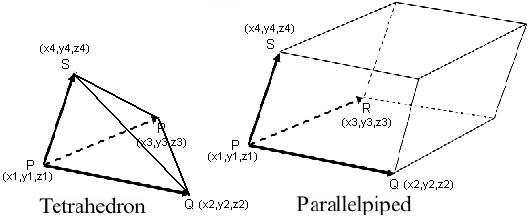
Formula of volume is :
The volume of tetrahedron is :
$$ \text{Tetrahedron volume} = \frac{ \text{Parallelepiped volume (V)}} {6}$$
Parallelepiped and Tetrahedron Volume Calculator
The Parallelepiped and Tetrahedron Volume Calculator is a free online geometry tool that calculates the volume of a parallelepiped and the corresponding tetrahedron from the coordinates of four vertices in three-dimensional space. Instead of manually evaluating lengthy vector expressions or expanding a determinant by hand, this calculator performs every mathematical operation automatically and presents the final results within seconds.
This calculator is useful for students studying coordinate geometry, vector algebra, engineering mathematics, linear algebra, computational geometry, and three-dimensional analytic geometry. It is equally valuable for teachers, engineers, architects, programmers, researchers, and anyone working with 3D coordinate systems. Whether your coordinates contain integers, decimals, or negative values, the calculator accurately determines the enclosed volume using the scalar triple product.
To use the calculator, enter the coordinates of the four vertices labelled P, Q, R, and S. Once the values are entered, click the Calculate button to instantly determine the volume of the parallelepiped and the volume of the tetrahedron. If you wish to understand every mathematical operation involved, click the Show Step-by-Step Solution button to display all intermediate calculations, including vector differences, determinant components, scalar triple product evaluation, and the final division required to obtain the tetrahedron volume.
Unlike many basic calculators that only provide the final numerical answer, this calculator explains the complete solution process. This makes it an excellent learning tool because users can verify their own manual calculations, understand the underlying mathematical concepts, and learn how the scalar triple product determines the volume enclosed by three vectors in space.
The calculator accepts positive numbers, negative numbers, decimal numbers, and zero coordinates. Since the scalar triple product may produce either a positive or negative value depending on the orientation of the vectors, the calculator automatically uses the absolute value so that the reported volume is always non-negative. This follows the standard mathematical definition of geometric volume.
What Is a Parallelepiped?
A parallelepiped is a three-dimensional solid whose six faces are parallelograms. It may be considered the three-dimensional counterpart of a parallelogram, just as a cube is the three-dimensional counterpart of a square. A parallelepiped is completely determined by three non-coplanar vectors that originate from the same vertex. These vectors define the length, width, height, and orientation of the solid in space.
Different types of parallelepipeds exist depending on the angles between their edges. When all adjacent faces are rectangles, the solid becomes a rectangular prism. If all edges are equal and every angle is a right angle, it becomes a cube. More generally, the faces may be slanted, producing an oblique parallelepiped while still preserving the property that opposite faces remain parallel and congruent.
One of the most important mathematical properties of a parallelepiped is its volume. In vector mathematics, the volume is determined using the scalar triple product of the three edge vectors. Geometrically, this value measures the amount of three-dimensional space enclosed by the vectors. Algebraically, it is equal to the determinant of a 3 × 3 matrix formed from the vector components. If the determinant is negative, only the orientation of the vectors differs; the geometric volume is obtained by taking the absolute value.
Parallelepipeds appear in many scientific and engineering disciplines. Structural engineers use vector methods to analyse forces acting on three-dimensional objects. Computer graphics software performs geometric transformations using vector operations closely related to those used for volume calculations. Robotics systems use coordinate transformations that rely on similar mathematical concepts, while crystallography often models crystal structures using unit cells that are parallelepipeds.
Because of these applications, understanding the geometry and volume of a parallelepiped is an important topic in higher mathematics, engineering, computer science, architecture, and physics.
What Is a Tetrahedron?
A tetrahedron is one of the five Platonic solids and is the simplest three-dimensional polyhedron. It consists of four triangular faces, six edges, and four vertices. Every face is a triangle, and three faces meet at each vertex. When all edges have the same length, the solid is called a regular tetrahedron, and all four faces are congruent equilateral triangles.
Not every tetrahedron is regular. In coordinate geometry, the vertices may be located anywhere in three-dimensional space, resulting in an irregular tetrahedron. The calculator on this page works for both regular and irregular tetrahedra because it uses coordinate geometry instead of edge lengths alone. This makes it suitable for solving a wide variety of practical mathematical problems.
A useful geometric relationship exists between a tetrahedron and a parallelepiped formed from the same three edge vectors. The volume of the tetrahedron is exactly one-sixth of the volume of the corresponding parallelepiped. This relationship follows directly from vector geometry and the scalar triple product. After the calculator determines the parallelepiped volume, it simply divides that value by six to obtain the tetrahedron volume.
Tetrahedra play an important role in many branches of science and engineering. Finite element analysis divides complex three-dimensional objects into thousands or millions of tetrahedra to simulate physical behaviour. Geological models use tetrahedral meshes to represent underground formations. Medical imaging software reconstructs anatomical structures using tetrahedral elements, while computer-aided design and computer graphics rely on tetrahedral meshes for efficient modelling and rendering.
In mathematics education, tetrahedra provide an excellent introduction to three-dimensional geometry, determinants, vector algebra, and coordinate transformations. Learning how to calculate their volume helps students understand the relationship between vectors, matrices, determinants, and geometric space.
Relationship Between a Parallelepiped and a Tetrahedron
The parallelepiped and the tetrahedron are closely connected through vector geometry. If three vectors originate from the same point, they define a unique parallelepiped. Using the same vectors together with the common starting vertex forms a tetrahedron occupying exactly one-sixth of the parallelepiped's volume. Consequently, once the scalar triple product has been evaluated, both volumes can be determined immediately without performing separate geometric calculations.
This relationship is especially useful because it eliminates the need for different formulas for different tetrahedra. Whether the tetrahedron is regular or irregular, the coordinate method remains identical. The calculator first evaluates the determinant representing the scalar triple product, converts it to a positive geometric volume by taking the absolute value, and finally divides the result by six. This efficient mathematical process provides accurate results while reducing the possibility of calculation errors.
Formula Used to Calculate the Volume of a Parallelepiped
The volume of a parallelepiped is calculated using the scalar triple product of three vectors that originate from the same vertex. The scalar triple product combines the cross product of two vectors with the dot product of the third vector. Geometrically, its absolute value represents the amount of three-dimensional space enclosed by the vectors.
Suppose the four vertices are P(x₁,y₁,z₁), Q(x₂,y₂,z₂), R(x₃,y₃,z₃), and S(x₄,y₄,z₄). Three vectors are formed from the common vertex P:
$$ \overrightarrow{PQ},\; \overrightarrow{PR},\; \overrightarrow{PS} $$These vectors create the edges of the parallelepiped. Their scalar triple product gives the signed volume, while the absolute value gives the actual geometric volume.
$$ V=\left|\overrightarrow{PS}\cdot (\overrightarrow{PQ}\times\overrightarrow{PR})\right| $$Expanding the determinant gives the coordinate formula:
$$ V=\left| (x_4-x_1)\left[(y_2-y_1)(z_3-z_1)-(z_2-z_1)(y_3-y_1)\right] $$ $$ +(y_4-y_1)\left[(z_2-z_1)(x_3-x_1)-(x_2-x_1)(z_3-z_1)\right] $$ $$ +(z_4-z_1)\left[(x_2-x_1)(y_3-y_1)-(y_2-y_1)(x_3-x_1)\right] \right| $$Because volume is always non-negative, the calculator automatically takes the absolute value of the determinant before displaying the final answer.
Formula for the Volume of a Tetrahedron
The tetrahedron occupies exactly one-sixth of the parallelepiped formed by the same three edge vectors. Therefore, once the parallelepiped volume has been calculated, the tetrahedron volume is obtained by dividing by six.
$$ \boxed{ V_{tetrahedron} = \frac{V_{parallelepiped}}{6} } $$This simple relationship allows both volumes to be calculated from a single determinant evaluation.
How to Calculate the Volume Manually
Although the calculator performs all computations automatically, understanding the manual method helps build a deeper understanding of vector geometry and determinants. The calculation can be completed in five straightforward steps.
Step 1 — Enter the Coordinates
Write the coordinates of the four vertices P, Q, R, and S. These points define the three-dimensional solid.
Step 2 — Construct Three Edge Vectors
Subtract the coordinates of vertex P from the remaining vertices to obtain the vectors:
$$ \overrightarrow{PQ}, \qquad \overrightarrow{PR}, \qquad \overrightarrow{PS} $$These vectors represent the three edges that meet at vertex P.
Step 3 — Evaluate the Scalar Triple Product
Compute the determinant or scalar triple product using the vector components. This produces the signed volume.
Step 4 — Take the Absolute Value
If the determinant is negative, only the orientation of the vectors differs. The geometric volume is therefore obtained by taking the absolute value.
Step 5 — Divide by Six
Divide the parallelepiped volume by six to determine the volume of the tetrahedron.
The calculator performs these operations automatically while also displaying each intermediate step when the Show Step-by-Step Solution option is selected.
Why Is the Absolute Value Used?
The determinant of three vectors may be positive or negative depending on the order in which the vectors are arranged. A positive determinant indicates one orientation, while a negative determinant indicates the opposite orientation. Since physical volume cannot be negative, the absolute value is always taken before displaying the result.
For example, a determinant of −48 and a determinant of +48 represent the same geometric volume. The calculator therefore returns 48 cubic units in both cases.
Applications of Parallelepiped and Tetrahedron Volume
Volume calculations based on vectors are widely used across mathematics, engineering, and science. Some of the most common applications include:
-
Engineering Design
Mechanical and civil engineers calculate volumes of three-dimensional structures, support members, and geometric components during design and analysis. -
Computer Graphics
Three-dimensional graphics engines use vectors and matrices to transform objects, calculate spatial relationships, and build realistic virtual environments. -
Architecture
Architects analyse complex geometric forms and estimate material quantities using three-dimensional coordinate systems. -
Robotics
Robot motion planning depends heavily on coordinate transformations and vector mathematics similar to the calculations used in this calculator. -
Finite Element Analysis
Engineering simulation software divides complex solids into tetrahedral elements. Accurate tetrahedron volume calculations are essential for obtaining reliable simulation results. -
Geology
Geological models frequently represent underground formations using tetrahedral meshes to estimate rock volumes and mineral distributions. -
Medical Imaging
MRI and CT scan reconstruction often uses tetrahedral meshes to model organs and biological tissues. -
Mathematics Education
Students studying vector algebra, determinants, and coordinate geometry use parallelepiped and tetrahedron problems to understand three-dimensional geometry.
Advantages of Using This Calculator
- Calculates both parallelepiped and tetrahedron volumes simultaneously.
- Accepts positive, negative, and decimal coordinates.
- Eliminates lengthy manual determinant calculations.
- Provides detailed step-by-step solutions.
- Uses the mathematically correct absolute value.
- Produces fast and accurate results.
- Works on desktop, tablet, and mobile devices.
- Suitable for homework, examinations, research, and professional work.
Common Mistakes When Calculating Volume
Many students obtain incorrect answers because of small arithmetic mistakes. The following are some of the most common errors.
- Subtracting coordinates in the wrong order.
- Using different starting vertices for different vectors.
- Expanding the determinant incorrectly.
- Forgetting to use the absolute value.
- Failing to divide by six when calculating the tetrahedron volume.
- Entering coordinates in the wrong row of the calculator.
- Ignoring negative signs during multiplication.
- Rounding intermediate values too early.
The calculator minimizes these errors by performing every calculation automatically and presenting the complete solution process.
Solved Examples
The following examples demonstrate how the calculator determines the volume of a parallelepiped and the corresponding tetrahedron from four vertices in three-dimensional space. These examples are intended to help students verify their understanding of the scalar triple product and coordinate geometry.
Example 1
Given Coordinates
- P = (0, 0, 0)
- Q = (2, 0, 0)
- R = (0, 3, 0)
- S = (0, 0, 4)
Solution
The three vectors are:
$$ \overrightarrow{PQ}=(2,0,0) $$ $$ \overrightarrow{PR}=(0,3,0) $$ $$ \overrightarrow{PS}=(0,0,4) $$Scalar Triple Product:
$$ 2\times3\times4=24 $$Parallelepiped Volume = 24 cubic units
Tetrahedron Volume $$ =\frac{24}{6}=4 $$ Answer: 4 cubic units.
Example 2
Given Coordinates
- P = (1,2,1)
- Q = (5,2,1)
- R = (1,6,1)
- S = (1,2,7)
The vectors are mutually perpendicular with lengths 4, 4 and 6.
Parallelepiped Volume $$ =4\times4\times6=96 $$
Tetrahedron Volume $$ =\frac{96}{6}=16 $$ Answer: 16 cubic units.
Example 3
Given Coordinates
- P = (0,1,2)
- Q = (3,2,1)
- R = (2,5,4)
- S = (4,3,8)
After forming the three vectors and evaluating the scalar triple product, the determinant equals 42.
Parallelepiped Volume = 42 cubic units
Tetrahedron Volume $$ =\frac{42}{6}=7 $$
Example 4
Given Coordinates
- P = (-2,-1,0)
- Q = (3,-1,0)
- R = (-2,2,0)
- S = (-2,-1,5)
Parallelepiped Volume $$ =5\times3\times5=75 $$
Tetrahedron Volume $$ =\frac{75}{6}=12.5 $$
Example 5
Given Coordinates
- P = (2,1,4)
- Q = (5,2,4)
- R = (2,6,5)
- S = (4,2,9)
Scalar Triple Product = 51
Parallelepiped Volume = 51 cubic units
Tetrahedron Volume $$ =\frac{51}{6}=8.5 $$
Frequently Asked Questions (FAQs)
1. What is a parallelepiped?
A parallelepiped is a three-dimensional solid whose six faces are parallelograms. Opposite faces are parallel and congruent.
2. What is a tetrahedron?
A tetrahedron is a polyhedron consisting of four triangular faces, four vertices, and six edges.
3. What formula is used in this calculator?
The calculator uses the scalar triple product of three vectors formed from one common vertex.
4. Why is the absolute value taken?
The determinant may be negative because of vector orientation, but geometric volume is always positive.
5. Why is the tetrahedron volume divided by six?
A tetrahedron occupies exactly one-sixth of the parallelepiped defined by the same three vectors.
6. Can I use decimal coordinates?
Yes. The calculator supports integers, decimals, positive numbers, negative numbers, and zero values.
7. Does the order of the vertices matter?
Yes. Changing the order may change the sign of the determinant, but the calculator automatically reports the positive geometric volume.
8. Can the volume ever be negative?
No. Although the determinant can be negative, the calculator displays the absolute value.
9. Is this calculator suitable for students?
Yes. The calculator includes a detailed step-by-step solution that helps students learn vector geometry and determinant calculations.
10. Where are these calculations used?
Applications include engineering, architecture, robotics, computer graphics, computational geometry, finite element analysis, medical imaging, and physics.
Tips for Accurate Results
- Double-check every coordinate before clicking the Calculate button.
- Keep the order of the vertices consistent throughout the calculation.
- Use the step-by-step solution to verify manual calculations.
- Do not round intermediate values unless necessary.
- Remember that the tetrahedron volume is always one-sixth of the parallelepiped volume.
- If the determinant is negative, the calculator automatically converts it into a positive volume.
Conclusion
The Parallelepiped and Tetrahedron Volume Calculator provides a fast, reliable, and educational method for determining the volume of two important three-dimensional geometric solids. By using the scalar triple product, the calculator eliminates lengthy manual computations while maintaining mathematical accuracy. The integrated step-by-step solution allows students to understand each stage of the calculation, making the tool valuable for both learning and professional applications.
Whether you are solving coordinate geometry problems, verifying homework, studying vector algebra, analysing engineering models, or working with three-dimensional computer graphics, this calculator delivers accurate results together with clear mathematical explanations. It supports positive, negative, and decimal coordinates, making it suitable for a wide range of real-world and academic calculations.